I'm really running out of puns for titles. In this post I wanted to talk some more about Binary Search Trees. But more specifically how to balance them - that's where I left off on my lat post.
The most common technique for balancing a tree is rotation. Rotating a tree is quite simple:
Lets say we have a tree:
20
/ \
10 30
/\
5 15
If we rotate it right we get
10
/ \
5 20
/ \
15 30
And vice versa.
As you can see that really didn't help much since the balance of left and right only differed by 1.
But if it differs by 2..
1
\
2
\
3
Rotate left and...
2
/ \
1 3
Bam! A balanced tree. A tree like that will become way more efficient add items to.
Actually properly implementing tree rotation is a lot more complicated, but feel free to give it a shot and let me know how it goes.
What I just showed you is based off an AVL tree(see link below).
There is also a different way to balance - using red-black trees.
It still uses rotation but the way it figures out what to rotate is a little different.
Check it out below!
I've thrown in some links here for you guys to check out if you'd like to learn more:
http://pages.cs.wisc.edu/~ealexand/cs367/NOTES/AVL-Trees/index.html
http://www.cs.auckland.ac.nz/software/AlgAnim/red_black.html
Once again, thanks for reading. I'll probably make another post this week so stay tuned!
Monday, 2 December 2013

Sunday, 1 December 2013
Sorting it all out
Well, I have missed a couple of SLOG entries over this term, so I’m gonna try to make up for it by posting a few today. In this one I want to talk about sorting algorithms. (In the spirit of holidays this post also includes lots of flashing coloured things) We went over the basic and/or most common sorts:
Bubble
Selection
Quick
and last but not least Merge
Bubble
 |
| Image by Wikipedia User Swfung8 |
Insertion
 |
| Image by Wikipedia User Swfung8 |
Selection
 |
| Image by Wikipedia User Joestape89 |
Quick
 |
| Image by Wikipedia User Matt Chan |
and last but not least Merge
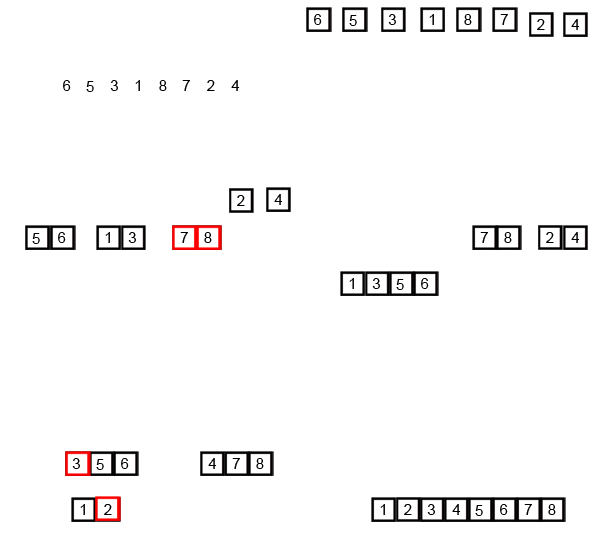 |
| Image by Wikipedia User Swfung8 |
However the world of sorting doesn't end there. One sort I thought of, and I believe we may have done in class was using a binary tree to sort. You make a Binary search tree and add items accordingly, and then do an inorder traversal of it. The performance of such a sort is quite good: O(n log n) on average )( n) in best case. The worst case is a bit more interesting though where you can have a balanced or unbalanced BST. Balanced means the tree's height is the minimum (or close to) of what it can be (log2 n [thats "log base 2 of n"]) and unbalanced means it is more. Balancing a tree can be quite the overhead but it doesn't have to happen upon every insertion.
The difference in worst case performance is O(n log n) for balanced and O (n^2) for unbalanced.
Balancing a tree seems rather tricky and I have yet to figure it out exactly, but I hope this sparks some interest in some of you.
Anyways that concludes this post, see you guys next week (actually like a few hours).
Subscribe to:
Posts (Atom)