Bubble
 |
| Image by Wikipedia User Swfung8 |
Insertion
 |
| Image by Wikipedia User Swfung8 |
Selection
 |
| Image by Wikipedia User Joestape89 |
Quick
 |
| Image by Wikipedia User Matt Chan |
and last but not least Merge
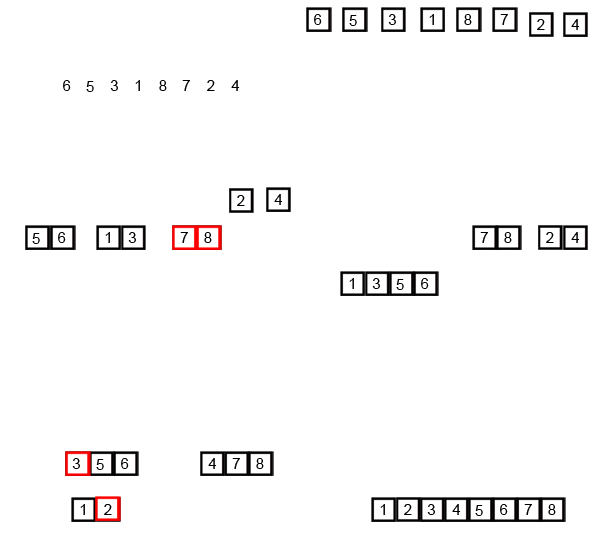 |
| Image by Wikipedia User Swfung8 |
However the world of sorting doesn't end there. One sort I thought of, and I believe we may have done in class was using a binary tree to sort. You make a Binary search tree and add items accordingly, and then do an inorder traversal of it. The performance of such a sort is quite good: O(n log n) on average )( n) in best case. The worst case is a bit more interesting though where you can have a balanced or unbalanced BST. Balanced means the tree's height is the minimum (or close to) of what it can be (log2 n [thats "log base 2 of n"]) and unbalanced means it is more. Balancing a tree can be quite the overhead but it doesn't have to happen upon every insertion.
The difference in worst case performance is O(n log n) for balanced and O (n^2) for unbalanced.
Balancing a tree seems rather tricky and I have yet to figure it out exactly, but I hope this sparks some interest in some of you.
Anyways that concludes this post, see you guys next week (actually like a few hours).

That was a really good post! I didn't realize that the worst case performance occurs due to a tree being unbalanced. Any ideas how to go about balancing a tree?
ReplyDeleteThat's actually gonna be my next post! I'm going to have it up tonight. Stay tuned!
DeleteI also look forward to reading about balanced and unbalanced trees. New things, always good to know new things.
DeleteThere are special algorithms that balance a tree which are covered in later courses.
ReplyDeleteI also like the animated representations of the sorts.